What Happens to Your Automatic Gate During a Power Cut?
In Kenya this isn’t a hypothetical. If you automate a gate, you’ll be using it during an outage sooner or later, so it’s worth knowing exactly what it will do and what it won’t.
What should happen
Every properly installed gate system includes a sealed battery that sits behind the control board and stays topped up from the mains. When the power goes, the control board switches to the battery automatically. You press the remote, the gate opens and closes as normal, and you may not notice anything has changed at all.
If your gate does nothing when the power goes, the battery is either missing, flat, or past its life. We cover how to tell in our maintenance schedule post, but the short version is: test it before you need it.
Not sure your gate has working backup? Call or WhatsApp us on +254 722 708034 and we’ll check it.
How long does the battery last?
It depends on the battery size, its age, and how often the gate cycles. A standard backup battery on a lightly used residential gate can carry it through many open-and-close cycles, which is enough for a typical outage. A busy gate, such as an estate entrance, uses the battery much faster. Long outages, or a battery that’s several years old, shorten the number of cycles you get.
As a rough rule, assume less than you’d hope. A battery that’s two or three years old holds noticeably less than a new one, and if you’re hoping to get through a full day of heavy use on backup alone, you probably won’t.
When the battery runs flat
If an outage runs long enough to drain the battery, the gate stops. That’s when the manual release matters. Every system has a key or lever that disconnects the motor so the gate can be pushed by hand. Know where it is, keep the key somewhere accessible, and make sure everyone in the household knows how to use it. Fumbling for it in the dark during your first flat-battery outage is not the time to learn.
Reducing how often this happens
Fit a bigger or additional battery for gates that cycle often. Replace batteries on schedule, typically every two to four years, rather than waiting for failure. Add a solar kit for properties with frequent or long outages, or no reliable grid at all. A solar panel recharges the battery every day, so the gate doesn’t depend on the mains. We cover this in our guide to solar-powered gate automation.
Dealing with long outages in your area and wondering whether solar makes sense? Email info@automaticgates.co.ke and tell us how often the power goes and for how long.
What not to do
Don’t leave a gate in manual mode and forget about it. It’s a security hole, and a gate left disengaged can swing or roll freely. Re-engage the motor once power is back, and check that the gate runs normally.
Don’t force a gate by hand without releasing the motor first. You can damage the gears.
A note on your remotes and intercom
Remotes and the control board run off the backup battery, so they keep working. A video intercom may or may not stay powered during an outage depending on how it was wired, so ask your installer during setup. See our video intercom buying guide for more.
The honest summary
A well-installed gate with a healthy battery handles a normal outage without trouble. The failures we see are almost always the same: a battery that’s old and untested, and a household that doesn’t know where the manual release is. Both are fixable in a few minutes.
Get in touch or call +254 722 708034 and we’ll test your backup, replace the battery if it’s due, or talk through a solar option.

Video Intercom Systems for Kenyan Homes and Estates
A gate motor gets you an opening and closing gate. An intercom is what lets you know who's on the other side of it before you decide to open it at all. Here's what's worth [...]
Gate Automation for Estates and Apartment Blocks
A single-household gate is a fairly simple decision. An estate or apartment block is a different problem entirely — you're managing access for dozens of residents, visitors, deliveries, and staff, all without turning the entrance [...]
Centurion vs Nice Hansa — Which Gate Motor Should You Choose?
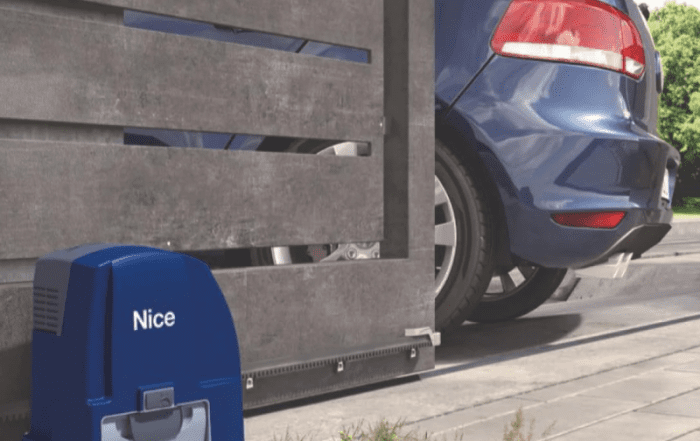
These are the two brands we install and stand behind, and the question we get constantly is simply "which one." Here's an honest comparison, rather than a sales pitch for whichever we happen to have [...]
Solar-Powered Gate Automation — How It Works and Why It Matters
If you've ever been stuck outside your own gate during a KPLC outage, fumbling for the manual release key in the dark, you already understand why solar gate automation exists. Here's how it actually works, [...]