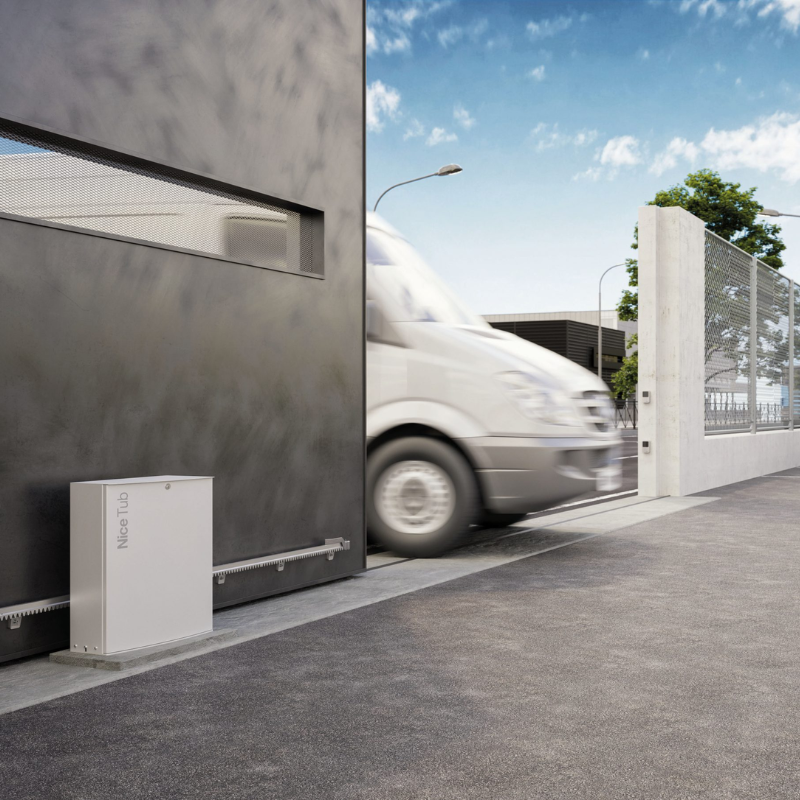
Nice TUB 4000 Sliding Gate Operator
The Nice TUB 4000 sliding gate operator is a premium heavy‑duty solution designed for large gates, industrial installations and commercial sites. It’s built to handle significant loads — gates up to around 4,000 kg — while offering reliable automation, safety features and long‑term durability in challenging conditions.
If you’re in Kenya and planning to automate a large perimeter gate for an estate, factory or high‑traffic entrance, the TUB 4000 is a top contender.
Overview of the Nice TUB 4000
Here’s a quick snapshot of what sets the TUB 4000 apart:
-
Designed for sliding gates up to 4,000 kg in weight.
-
Operates on a three‑phase 400 V AC supply (industrial grade).
-
Built-in control unit for programming, safety diagnostics and advanced features.
-
Robust mechanical design: electromechanical irreversible gear motor, metal/bronze gears for longevity and quieter operation.
-
Adjustable features: slowdown, programmable functions, optional accessory expansion.
-
Typically used for industrial entrances, commercial perimeters or large residential gates needing serious capacity and durability.
Why Choose a Heavy‑Duty Sliding Gate Operator
When you have a large gate — whether because of width, mass, usage frequency or security demands — a light domestic operator won’t suffice. Here’s why the TUB 4000 (and similar heavy‑duty models) make sense:
-
Capacity & Strength: Handles gates up to ~4 t in mass, making it suitable for large metal or steel gates.
-
Durability: Designed for high-traffic usage, frequent cycles, and more demanding environments.
-
Safety & Reliability: With heavy gates you need stronger motors, better braking and intelligent controls to avoid damage or accidents.
-
Future-proofing: For growing properties, heavy load gates or commercial sites, investing in high capacity now avoids need to upgrade prematurely.
-
Security: Larger gates are often found at commercial/higher-security sites, so a robust automation system is a smart investment.
Components of the Nice TUB 4000 System
To deploy the TUB 4000 successfully you’ll interact with these main components:
-
Motor Unit / Gearbox: The core electromechanical drive mechanism, mounted for sliding motion and delivering the force.
-
Control Unit: Provides logic, safety, switching, and programming.
-
Rack & Pinion Mechanism: Metal or plastic rack affixed along the gate length, engages the gearbox pinion to slide the gate.
-
Safety Sensors & Accessories: Photocells, safety edges, manual release lever, slowdown settings, remote controls, etc.
-
Manual Release / Emergency Mechanism: In case of power failure or fault, manual operation is possible.
-
Foundation / Mounting Hardware: Ensuring proper mounting base, alignment and supports is key.
Technical Specifications
Here are key specs for the TUB 4000 — these serve as a benchmark when comparing or planning installation:
| Specification | Value (approx) |
|---|---|
| Maximum Gate Weight | Up to ~ 4,000 kg |
| Power Supply | 400 V AC, three‑phase |
| Output Power | ~580 W absorbed, peak thrust over 400 Nm |
| Speed | ~0.16 m/s (approx 9.6 m/min) |
| Duty Cycle | Up to approx 42 cycles per hour |
| Protection Class | IP 54 (or higher depending on variant) |
| Operating Temperature Range | –20 °C to +50 °C |
Installation Guide
Installing a system like the TUB 4000 involves careful planning and execution. Here’s a step-by-step overview:
-
Site Survey & Preparation
-
Measure the gate weight, length and travel path. Ensure the gate is well supported and glides smoothly.
-
Check the foundation for the motor mounting plate: Must be strong, level, and secure.
-
Ensure correct power supply is available (three‑phase 400 V if required).
-
Confirm clear path for the rack along the gate length, and no major obstacles or uneven track.
-
-
Motor & Control Unit Installation
-
Mount the motor unit on its foundation pad, aligning it with the gate rack.
-
Secure the control unit housing, connect incoming power, and wiring for accessories.
-
Mount the rack firmly on the gate, ensuring straight alignment and correct engagement with the pinion.
-
-
Wiring & Electrical Connections
-
Ensure proper three‑phase supply and correct earthing/grounding.
-
Connect safety devices, remote-receiver, end-of-travel switches or magnetic sensors.
-
Set up manual release lever for emergency manual operation.
-
-
Programming & Testing
-
Program settings: slowdown, torque/force limits, open/close distances, safety logic, remote channels.
-
Run several open/close cycles under full load to check smoothness, speed, reversal on obstacle, correct end stops.
-
Test manual release and emergency operation.
-
-
Commissioning & Handover
-
Complete user instruction: How to operate, manual release, maintenance schedule.
-
Provide documentation and warning signage.
-
Maintenance Best Practices
-
Inspect mounting bolts, rack teeth wear, motor alignment, gate travel smoothness every 3–6 months.
-
Lubricate moving parts, including rack, pinion, hinges or rollers.
-
Inspect wiring for wear, corrosion, proper earthing.
-
Test safety devices: photocells, safety edges, manual release.
-
Keep track clean of debris, dust or vegetation.
-
Ensure housing remains sealed to protect from harsh weather.
Safety Features & Compliance
-
Anti-crushing / obstacle detection: Gate reverses when excessive force is detected.
-
Manual release lever: Allows manual operation during power failure.
-
Electronic brake: Prevents uncontrolled motion.
-
Built-in controls with diagnostics: Allows fault logging and monitoring of safety devices.
-
Compliance: Designed for high-duty cycles and environmental protections.
Cost Considerations in Kenya
-
Equipment cost: Premium due to high capacity and industrial design.
-
Installation cost: Heavy gates require strong foundations and professional expertise.
-
Power supply: Upgrade to three-phase may be necessary.
-
Maintenance & spare parts: Budget for periodic inspections and parts replacement.
-
Return on investment: Improved security and reduced manpower for gate operation.
Troubleshooting Common Issues
-
Gate stalls or moves slowly: Check rack alignment, debris, motor overload, voltage drop.
-
Remote not responding: Check batteries, signal interference, programming.
-
Motor overheating: Duty cycle exceeded, mechanical binding, high ambient temperature.
-
Gate doesn’t reverse on obstruction: Check sensor wiring, configuration, alignment.
-
Excessive noise or vibration: Inspect rack and pinion, gear wear, foundation looseness.
Enhancing Security with the System
-
Integrate with CCTV and access control for monitoring and logs.
-
Enable remote monitoring and alerts for gate status.
-
Link to existing perimeter fence or alarm systems.
-
Use scheduled operation and lock-down modes.
-
Heavy-duty build acts as a deterrent.
Comparative Analysis
| Feature | Nice TUB 4000 | Competitor Heavy Unit |
|---|---|---|
| Max Gate Weight | ~4,000 kg | Slightly less |
| Power Supply | 400 V AC three-phase | May vary |
| Control Unit Integration | Built-in control | May require separate board |
| Mechanical Build | Metal & bronze gears | Cheaper materials |
| Cost | High | Lower but less capacity |
| Duty Cycle/Usage | Up to ~42 cycles/hour | Lower duty cycle |
Customer Reviews & Use Cases
-
Industrial sites: Smooth operation and reliable performance for 3–4 t gates.
-
Commercial estates: Handles high traffic and heavy steel gates effectively.
-
Coastal areas: Requires protective measures for humidity, dust, and salt exposure.
Frequently Asked Questions (FAQs)
Q1: Can it be used for typical residential gates?
A1: Yes, but it’s designed for very heavy gates and industrial supply.
Q2: What power supply is required?
A2: 400 V AC three-phase supply is common.
Q3: How often should maintenance be done?
A3: Every 3–6 months for inspection, annually for full check.
Q4: What happens during a power outage?
A4: Manual release lever allows gate operation; optional backup supply can be used.
Q5: Can it integrate with existing access control or CCTV systems?
A5: Yes, the control unit supports remote integration with access systems.
Q6: Is it suitable for harsh coastal environments?
A6: Yes, with additional protection for corrosion, sealing, and regular inspections.
Conclusion & Recommendation
The Nice TUB 4000 Sliding Gate Operator is ideal for heavy, high-usage sliding gates in industrial, commercial, or large residential properties in Kenya. Its strength, reliability, and safety features make it a worthwhile investment for large-scale automation projects. Proper site preparation, power supply, and maintenance are key to maximizing its performance.
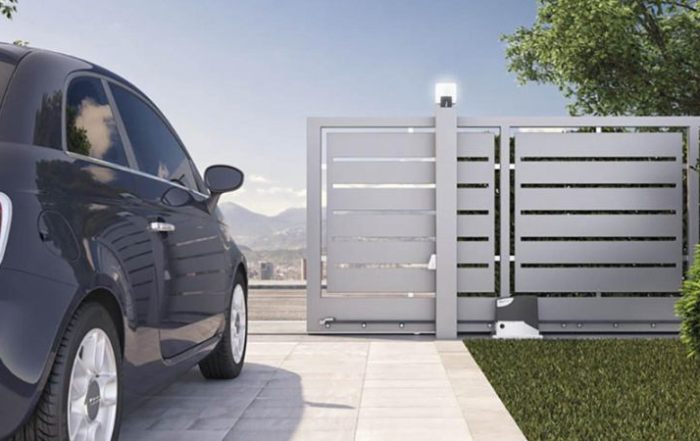
Automatic Gate Motor Prices in Kenya: How Much Should You Budget?
If you are searching for an automatic gate motor price in Kenya, you will probably notice that prices vary quite a lot. You may find one motor advertised at KSh 50,000, another at KSh 100,000 [...]
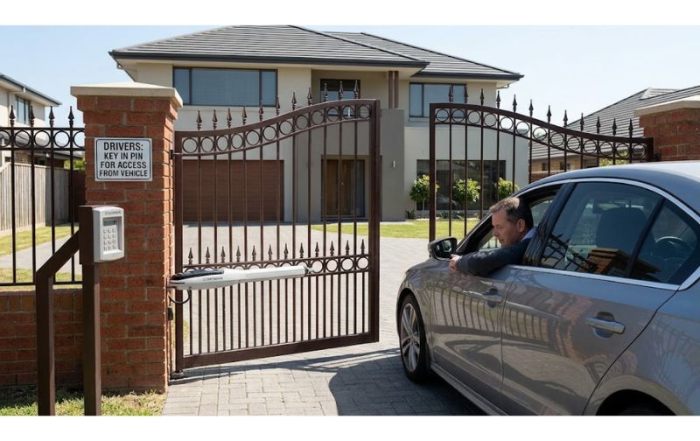
Keep Your Existing Gate. Upgrade the Automation: Automatic Gate Motor Replacement in Kenya
If your automatic gate is becoming unreliable, you may not need to replace the entire gate. In many cases, the gate itself is still in good condition. The problem may simply be an old, worn-out [...]
Keep Your Existing Gate. Upgrade the Automation: Gate Motor Replacement in Kenya
Your gate is still strong. Your gate is still in good condition. So why replace the whole gate? If your automatic gate has started giving you problems, the issue may simply be the gate motor [...]

Not Sure Which Gate Motor You Need? Send Us 3 Photos on WhatsApp
Choosing the right automatic gate motor in Kenya can be confusing, especially if you are not sure about the weight of your gate, the type of gate motor required, or which brand will work best. [...]